|
From its legendary first performances in May 1909 at the Theatre du
Chatelet, the Ballets Russes did more for Parisian audiences than just present
them with new choreography, new music, new stars, and a new performing company.
These productions redefined ballet for the twentieth century, reinventing an
entire art form that had grown stale elsewhere in Europe. At Russia's Imperial
theaters and ballet school, the traditions of ballet, rooted in the court dances
of Louis XIV's reign and Italian pantomime were not only preserved, but nurtured
and developed further. With extensive financial support from the Tsar's coffers,
few corners were cut in the training of dancers, the hiring of choreographic and
performing talent, and the staging of productions. It was in St. Petersburg that
all of Diaghilev's great choreographers, and many of his star and corps de ballet
dancers were trained. Fokin, Nijinsky, Massine, Nijinska, and Balanchine were
all the products of the Imperial Ballet School, and began their dance careers
at the Mariinsky theater, as did Karsavina, Pavlova, Danilova, Lopokova and
countless others.
The first Ballets Russes ballet actually premiered in Russia and
had nothing at all to do with Diaghilev. Pavillon d'Armide was the brainchild
of the artist, critic and historian Alexandre Benois, an avid balletomane whose
grandfather had built the Mariinsky Theater. Benois wrote the libretto of the
ballet in 1903 and Nikolai Tcherepnin composed the music to suit the plot, in
close consultation with Benois. The ballet was bought by the Mariinsky, but
left unstaged until Mikhail Fokin, a brilliant young choreographer and
balletmeister there came across it, staging a segment of it as a graduation
performance for the students of the Imperial Ballet School. The success of this
performance led to renewed interest in the ballet for the Mariinsky's main stage,
and in 1907 Fokin and Benois staged the ballet together, with sets and costumes
designed by Alexandre. A scholar of not only art but dance history, Benois
worked throughout with Fokin on the stage direction and even choreography of the
piece, especially the numbers involving large groups of dancers. Benois' great
friend, Diaghilev was present at the opening and was conquered by the
performance, finally agreeing with Benois' advice that he should bring not only
opera but ballet productions to Paris. Le Pavillon d'Armide demonstrated both
Fokin's innovative approach to choreography, and Benois' ideas about
collaborative creation in the theater, where he felt directors, designers,
composers and performers should work together as one, to achieve aesthetic
unity. All this would become the foundation of the Ballets Russes as a company,
and would ensure its Parisian success.
The Ballets Russes' twenty-year existence can be broken up into
approximate choreographic periods. 1909-1914 was the Fokin era, and it was he
who not only created most of the company's ballets, but also maintained the
troupe as balletmeister. Fokin's seminal choreographic works, performed
frequently to this day, include Les Sylphides, Scheherezade,
Firebird, Petrushka, and Spectre de la Rose. He also created
numerous other productions that are less well known today because the complexities
of their staging and the lack of preserved choreography make them difficult to
put on, among them are Pavillon d'Armide, Daphnis et Chloe, and
Le Coq d'Or. A student of Fokin's from the Imperial Ballet School and
star of many of his choreographic compositions, Vaslav Nijinsky, eventually
became Diaghilev's choreographic protege. However, he managed to create just
three ballets before his 1913 marriage nearly ended his career. Insanely jealous,
Diaghilev fired Nijinsky, and re-hired him only briefly in 1916 when Nijinsky
danced in the Ballets' North American tour and created one last ballet,
Till Eulenspiegel. Although his work as a choreographer was brief, it was
significant; in Prelude a l'apresmidi d'un Faune, Le Sacre du Printemps
and Jeux, Nijinsky departed even further than Fokin from the traditional
vocabulary of movement, progressing more in the direction of modern dance than
in the continuation of ballet tradition resumed by his successor, Leonid Massine.
Principal choreographer as well as star dancer after the departure
of both Fokin and Nijinsky, Massine led the company from 1915 to 1921. Among his
innovative choreographic works of the period were Le Soleil de Nuit,
La Boutique Fantastique, and Le Tricorne. When, after years as
Diaghilev's lover, Massine declared his independence by marrying and refusing to
allow himself to be bullied by his sometimes overbearing boss, he nevertheless
remained tied to the Ballets Russes. From 1932 to 1937 he was the chief
choreographer of the Colonel de Basil Ballets Russes, a successor company,
before leaving with a group of discontented dancers to start his own troupe,
the Ballet Russe de Monte Carlo. In the de Basil Ballets, Massine had shared
the spotlight with two former colleagues, Bronislava Nijinska and George Balanchine.
A brilliant dancer herself, though not so beloved as her elder brother, Nijinska
had worked for Diaghilev for over a decade when she finally got her chance to be
a choreographer in 1923. Among the pieces she created at the Ballets Russes were
Les Noces, Le Train Bleu, and Les Biches. Balanchine was
her successor and the company's last major choreographer. After a knee injury
effectively ended his performing career in 1926, he concentrated his energies
on choreography and by Diaghilev's death in 1929 had created nine ballets,
including La Chatte, Apollon Musagete, Le Fils Prodigue and
Le Bal. Many of these starred Diaghilev's latest lover, Serge Lifar,
who might well have become the next balletmeister if Diaghilev had not died
soon after Lifar's first efforts in choreography. Altogether, the choreographers
and dancers of the Ballets Russes overturned many of the static conventions of
classical Ballet, and ushered in the era of modern dance while preserving a
sense of tradition and the heritage of the Russian ballet school.
During the 2009 festival, Boston Ballet will present a new evening
program of four of the groundbreaking short ballets from different phases in the
aesthetic evolution of the Ballets Russes. First performed in 1911,
Le Spectre de la Rose (the Specter of the Rose) is in essence a pas de
deux created by Mikhail Fokin specifically for the first two dancers to perform
it, Vaslav Nijinsky and Tamara Karsavina. In the ballet, a young girl returns
home from her society debut at a ball. She dreams that she dances with the rose
she held at the ball, whose specter was danced by Nijinsky, causing quite a sensation.
Audiences were particularly enraptured by his final athletic leap out of the girl's
window, which ended both the girl's reverie and the ballet itself.
Nijinsky's first choreographic effort, Prelude a l'apresmidi d'un
Faune (Prelude to the Afternoon of the Faun) was the most controversial
performance of the Ballet Russe in 1912, signaling the beginning of a shift
towards modernism. In the ballet, Nijinsky completely fulfilled Diaghilev's
expectations of a revolutionary and provocative dance. The plot centers on a
faun who unsuccessfully flirts with nymphs. When the nymphs run away, leaving
behind a scarf belonging to one among them, the faun plays with the scarf ending
the ballet with simulated masturbation. Nijinsky's performance as the faun was
powerful, virile, and even animalistic, according to some observers, who were
mostly shocked by the ballet's overt sexuality, which went far beyond the
subtler eroticism of Fokin ballets like Cleopatre and Scheherezade.
Le Sacre du Printemps (The Rite of Spring) went even further, in 1913,
towards flouting old conventions. While Fokin's work was stylized and aestheticised,
Nijinsky moved towards the primitive, choreographing jerky movements and sharp
body angles that reflected Stravinsky's extremely rhythmic and avant-garde score.
Once again, sex was the subject, depicting old mythologized Russian fertility rites,
which included human sacrifice. The first presentation of the Ballet created such
a stir that fights broke out in the audience, which could only be stopped by the
eventual arrival of the police.
Balanchine's Le Fils Prodigue, (The Prodigal Son) was one of
the last productions premiered by the Ballets Russes. Based on the biblical
tale, it was more narrative and less abstract than some of Balanchine's other
works, reflecting his neoclassical approach to ballet.
|

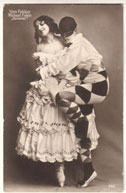
Mikhail Fokin and Vera
Fokina in 'Carnaval',
1911
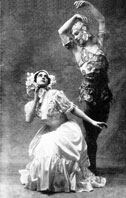
Vaslav Nijinsky and
Tamara Karsavina in
'Le Spectre
de la Rose',
1911
|


