Rebecca Rice Dance to premiere new choreography at Symphony Hall
To the sounds of the Boston Pops orchestra's playing on Tuesday May 19th,
Rebecca Rice Dance will present brand new choreography by Rice set to music by
Stravinsky, Prokofiev, Khachaturian and Shostackovich at Symphony Hall.
In the spirit of the Ballets Russes, this piece brings together music, art
and movement into a novel and unified whole. Brad Schlagheck, of
the Boston Ballet, Adrina DeVitre, Carrie Kerstein, Sara Knight and Janine
Ronayne perform in original costumes by Amanda Mujica.
www.rebeccaricedance.com
Boston Ballet spans the Ballets Russes, from Fokine to Balanchine
During the 2009 festival, Boston Ballet will present a new evening program
of four of the groundbreaking short ballets from different phases in the aesthetic evolution of
the Ballets Russes. Le Spectre de La Rose, L'Apres-midi d'un Faune, and Le Fils Prodigue
will be performed with the original choreography by Fokin, Nijinsky and Balanchine, respectively.
However, Le Sacre du Printemps will be performed with all-new choreography by Jorma Elo.
First performed in 1911, Le Spectre de la Rose (The Specter of the Rose)
is in essence a pas de deux created by Mikhail Fokin specifically for the first two dancers to perform
it, Vaslav Nijinsky and Tamara Karsavina. In the ballet, a young girl returns home from her society debut
at a ball. She dreams that she dances with the rose she held at the ball, whose specter was danced by Nijinsky,
causing quite a sensation. Audiences were particularly enraptured by his final athletic leap out of the girl's
window, which ended both the girl's reverie and the ballet itself.
Nijinsky's first choreographic effort, L'Apres-midi d'un Faune (Afternoon of a Faun)
was the most controversial performance of the Ballet Russe in 1912, signaling the beginning of a shift towards
modernism. In the ballet, Nijinsky completely fulfilled Diaghilev's expectations of a revolutionary and provocative
dance. The plot centers on a faun who unsuccessfully flirts with nymphs. When the nymphs run away, leaving behind a
scarf belonging to one among them, the faun plays with the scarf ending the ballet with simulated masturbation.
Nijinsky's performance as the faun was powerful, virile, and even animalistic, according to some observers, who were
mostly shocked by the ballet's overt sexuality, which went far beyond the subtler eroticism of Fokin ballets like
Cleopatre and Scheherezade.
Le Sacre du Printemps (The Rite of Spring) went even further, in 1913, towards flouting
old conventions. While Fokin's work was stylized and aestheticised, Nijinsky moved towards the primitive, choreographing
jerky movements and sharp body angles that reflected Stravinsky's extremely rhythmic and avant-garde score. Once again,
sex was the subject, depicting old mythologized Russian fertility rites, which included human sacrifice. The first presentation
of the Ballet created such a stir that fights broke out in the audience, which could only be stopped by the eventual arrival
of the police.
Balanchine's Le Fils Prodigue, (The Prodigal Son) was one of the last productions premiered by
the Ballets Russes. Based on the biblical tale, it was more narrative and less abstract than some of Balanchine's other works,
reflecting his neoclassical approach to ballet.
To purchase tickets for Boston Ballet preformance please follow this link Citi Performing Arts Center Box Office
|

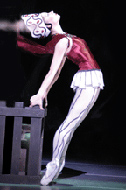
April Ball in The Prodigal Son
photo by Eric Antoniou
|


